

For some reason, there were no pictures on Google Images of socks and paper clips together, so, for your enjoyment, I have included a picture of David Hasselhoff as Knight Rider.
We are basically a country of indentured servants. We agree to a system where the poor (who are the vast majority) are forced to ask those who have more than enough to loan them money at interest in order to acquire the non-essential luxuries that they desire–Extravagancies like a college education and a roof over their head. But here’s the thing: Money is not real. We give it its value by agreeing as a society that it has value. If we decided that socks were the new currency, that would be how I would pay for filling up my gas tank–I would slide some socks into that little tray to give it to the lady behind the bullet-proof glass, and she would hand me my change in paper clips–per our new social contract.

When you're Yanni, it's alway Movember.
I have been struggling with this post for a few days now. It started out with my thoughts about debt–College loan debt in particular. Then it became about debt in a larger sense, and how America has woven debt into its plan for its citizens in order to keep them working like good little workers. And then today, I had to stumble upon an episode of This American Life called “The Invention of Money” (Here is the story. I would rather you listen to it than read one more word of this blog… Actually, I would rather you do both). This amazing and interesting story about how money is basically fiction did nothing to tighten the focus of this stupid blog entry. So now I’m completely lost in marco-mode, sitting here in my underwear on the couch listening to Yanni on Spotify, with 1500 words below this introductory paragraph that are basically a bunch of one-sentence thoughts–any one of which would be plenty for a blog entry of its own. This is not a blog topic; it’s a book. But now I have too much written down to not try to make sense of it all, so here goes….
Around 1 B.C., Roman author named Publilius Syrus said, “Debt is the slavery of the free.” So now I’m thinking–If money isn’t real, then debt isn’t real either.
So here’s what has struck me recently: It costs poor people more for things than it costs rich people. And here’s the kicker: That extra money that the poor have to pay? That money gets paid to the rich people. Let’s take the two examples of education and owning a home. If you want to go to college (The average for public colleges is a little more than $10,000/year, and the average for private colleges is $28,500/year, so let’s say $20,000/year for 4 years) and your family has the money to send you to college, it costs about $80,000. If you don’t have the money and you have to borrow, after you pay it back it could cost you an extra $20,000-$40,000. Same goes for paying for a place to live, except that paying off a $150,000 mortgage over 30 years will end up costing you about $250,000 compared to someone who has the money to pay it off right away.
"A fifth kid?!?! Just have him lay down sideways in the back seat...."
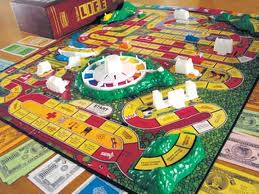
Now sure, I know that college isn’t everything. There is a giant list of people who go on to do great things who never went to college or who are college drop-outs (here is a list of drop-out billionaires), but the point is that, to kids, it is presented as the only way you’ll ever get a job. We’ve all played The Game of LIFE–If you take the short-cut and skip college, it’ll save you about 6 spaces, but every payday you and that thin little pink wife you’ll meet in a few spaces are going to get screwed. Of course, it doesn’t put you $20,000-$80,000 in debt to take that first right turn….
Basically, we’re all just a bunch of indentured servants. We go into debt to get some letters behind our name (and, admittedly, to learn some stuff) so that we can get hired so that we can pay off our newly acquired debt. Then, if we’re lucky enough to get a job that allows you to pay off your college loans (by the way, student loan debt in America is expected to top a trillion dollars this year–that’s a pretty big liability), we buy a house (It’s either that or throw your money away paying rent to someone who is rich enough to own apartments) and go into debt again. All of the sudden, it’s very important that you be a good employee and toe the line, or you could lose you job and your ability to pay back your mortgage debt (though it looks like you might owe more than it’s worth). Also, if you lose your job, you lose your health insurance–Another chain around the ankles of free men and women.
Okay, here’s how things work in America right now:
- If your family is poor, chances are you live in a poor neighborhood.
- If you live in a poor neighborhood, chances are you probably are going to a crap school and getting a crappier education (Unless your parents can afford to send you to a private school–which they can’t, because they’re poor).
- If you’re lucky enough to graduate from high school (with an education that increasingly pushes the burden of that year’s education to the next year’s teacher), you are informed that “a Bachelor’s degree is more like a high school diploma now-a-days” and if you want any hope of success in the world and getting a good job, you need to go to college.
- Turns out college is expensive, and you and your family can’t afford to pay for it. Because you’re poor. So now you need to “make the investment” of going into debt in order to insure bigger gains in the future.
- When you graduate (with an average $25,250 worth of debt–That’s quite a hole to dig out of), you figure out that what they said about “a Bachelor’s degree is more like a high school diploma” is actually true, and there are surprisingly few jobs. Maybe at this point you decide to go back to school (and more into debt) for a master’s degree–again, no guarantees. Or….
- Maybe you get a job. Maybe you’re lucky enough to get a job that supplies health insurance. Don’t lose your job, though. Be a good employee, or you’ll lose your job, your health insurance, and your ability to pay off your debt.
- Now you’ve got the choice of either pissing away your money to live in an apartment, or you can go even MORE into debt by borrowing money (in the form of a mortgage) in order to supposedly make your monthly payment (that we each need to make in order to have a roof over our heads) to yourself instead of to a landlord (Unfortunately, by the time you’ve paid off your $150,000 mortgage, you will have actually paid about $250,000 on your house–that is now probably worth $125,000).
- Congratulations! Your kids live in a crappy neighborhood and go to a crappy school! (Rinse, and repeat)

"Capitalism didn't do this... I hit my eye on a door knob."
This sounds nothing like freedom to me. This sounds more like a system that is set up so that the things a person needs in order to succeed are out of his price range, so he is forced to make a choice: Either you play by their rules and become indebted to the rich for a huge portion of your life, or you for forfeit your chance to become one of the ones who is lending and making the money. This doesn’t sound like a just society. This sounds like a fraternity hazing. Or a Nigerian inheritance scam. Or a battered woman staying with the man who beats her because it’s all she knows.

"My strategy works--As long as we don't all do it at once. If that happens, we're all screwed.
Then, if you don’t pay back your loan on their terms, they tell you that your credit rating is bad. Guess what–Your credit rating is basically just a number by which they rate how well you play by the rules of the people with the money. Imagine what would happen if we all just said, “You can take your credit rating and shove it up your ass.” Who would they lend to if we all had 520 credit ratings? Or, there’s the other side of it. What if we all took Dave Ramsey’s advice and lived modestly until we were out of debt? If either one of these things happened, the American economy would collapse. Think of how many people (whose jobs are dependent on the interest being paid by the poor to the rich) would be out of a job! And where would all of those companies be without Black Friday?
The Bible has some interesting (no pun intended) things to say about usury. When God spoke to Israel about lending at interest (especially through the prophets), it’s referred to as an abomination, and put in the same category as adultery, bribery, and extortion. In contrast to the person who takes usury and exploits the poor, Ezekiel 18:17 describes a righteous man who “helps the poor, does not lend money at interest, and obeys all my regulations and decrees. Such a person will not die because of his father’s sins; he will surely live.” Every time, God seems to be saying, “How dare you? How dare you exploit the poor in this way?” Then we’ve got to deal with the fact that Jesus tells us to pray saying “Forgive us our debts, as we forgive our debtors.” The word that is translated as “debtors” actually means “a person who is indebted to you.”–not a trespasser, not simply a person who has sinned against you—a debtor. It’s easier to say “I forgive you” to someone who has insulted you than it is to say “I forgive you” to someone who owes you money, but this “financial-debt forgiveness” is the word that Jesus used.
And the thing is, money is not real—that should make it easier for people to forgive debts. Money is fiction–love is real.





























 The Boeskool